




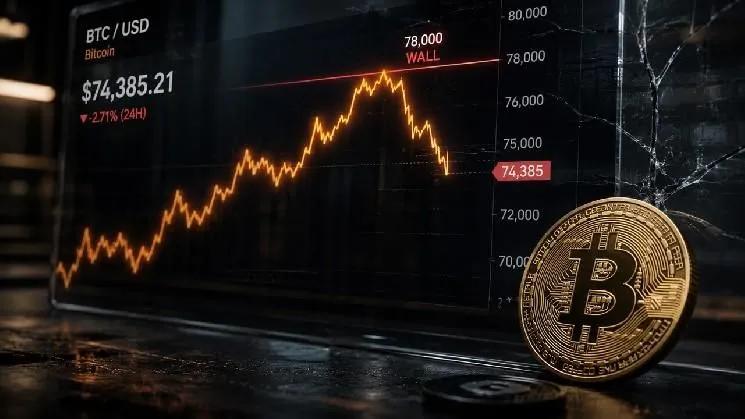
Bitcoin faller til 13. plass blant verdens største aktiva – men historien tyder på at historien kanskje ikke er over.










 Bitcoin (BTC)
Bitcoin has dropped to 13th place in the global asset ranking by market capitalization, reflecting a significant correction from its recent highs. Currently trading around $73,000, the world's largest cryptocurrency is down roughly 43% from its all-time high of approximately $126,000 reached in October 2025.
For many investors, the current situation appears discouraging. Market sentiment has weakened, social media discussions have become increasingly pessimistic, and concerns about the future direction of the crypto market continue to grow. However, when viewed through the lens of Bitcoin's historical performance, the current correction looks far less unusual than it may initially seem.
Volatility has always been one of Bitcoin's defining characteristics. Throughout its history, the asset has experienced multiple severe declines before recovering and eventually reaching new all-time highs. In fact, some of Bitcoin's strongest rallies began immediately after major market corrections.

One of the most notable examples occurred during the 2017 bull market. After rising rapidly, Bitcoin experienced a sharp decline from approximately $3,000 to $1,800, representing a correction of around 40%. At the time, many investors feared the rally was over. Instead, Bitcoin recovered and surged to nearly $19,800 by the end of the year.
A similar situation unfolded in 2020. During the market panic triggered by COVID-19, Bitcoin fell from around $10,000 to roughly $5,000, losing approximately 50% of its value in a short period. Despite this, the cryptocurrency staged one of its strongest recoveries, reaching approximately $64,500 just 13 months later.
The cycle repeated again in 2021. After reaching $64,500, Bitcoin experienced another correction, falling to nearly $29,000, a decline of roughly 55%. Many investors again questioned whether the bull market had ended. Yet only months later, Bitcoin hit a new all-time high near $69,000.
Perhaps the most dramatic example came during the 2022 bear market. Following the collapse of several major crypto companies and widespread fear across the industry, Bitcoin fell from around $69,000 to a low of approximately $15,476. This decline exceeded 78%, making it one of the harshest in its history.
At the time, many analysts declared the end of the cryptocurrency era. Nevertheless, Bitcoin once again demonstrated resilience. Over the following years, institutional adoption increased, market confidence gradually returned, and the asset eventually climbed to a record high of around $126,000 in 2025.
Looking across these historical examples reveals a recurring pattern. Corrections of 40% to 50% have happened multiple times throughout Bitcoin's existence. While each decline caused fear and uncertainty, the asset consistently recovered over time.
Historical data suggests that major recoveries often occurred within approximately nine to fourteen months following large corrections. While past performance cannot guarantee future results, these patterns are one reason many long-term investors remain optimistic despite current market weakness.

Another important factor is the growing role of institutional investors. Compared to previous cycles, Bitcoin is now significantly more integrated into traditional financial systems. Investment funds, publicly traded companies, and asset managers hold substantial positions in the asset, changing its overall market structure.
Supporters argue that temporary declines should be viewed within the context of long-term growth. Even after falling 43% from its peak, Bitcoin remains significantly higher than it was just a few years ago. From this perspective, corrections are not necessarily failures but part of its natural lifecycle.
Critics, however, point out that past recoveries do not guarantee future performance. Regulatory risks, macroeconomic conditions, and competition from other digital assets could all influence Bitcoin’s future direction.
What remains clear is that Bitcoin continues to attract global attention despite its volatility. Few assets have shown the ability to repeatedly recover from severe downturns while maintaining relevance across multiple cycles.
For investors watching today’s correction, history offers an important perspective. The current decline may feel significant, but it is not unprecedented. Similar drawdowns have occurred multiple times before and often preceded strong recoveries.

Whether history will repeat itself remains uncertain. However, if past cycles are any indication, periods of maximum pessimism have often come before some of Bitcoin’s strongest upward moves.
For now, Bitcoin sits well below its 2025 peak and outside the top ten global assets by market capitalization. Yet its long-term trajectory has repeatedly shown that major corrections are not always the end. In many cases, they have marked the beginning of the next chapter.


 Vellykket kopiert... Takk for at du deler innholdet vårt!:



5% innskuddsbonus opp til 100 perler

0 % gebyrer på innskudd og uttak.





11 % innskuddsbonus + FreeSpin


10 % EKSTRA INNSKUDDSBONUS + 2 GRATISSPINN PÅ HJUL

Gratis case og 100 % velkomstbonus


5 gratis saker, daglig gratis og bonus

3 gratiskasser og en bonus på 5 % på alle kontantinnskudd.

+5 % til innskudd




Kommentarer