




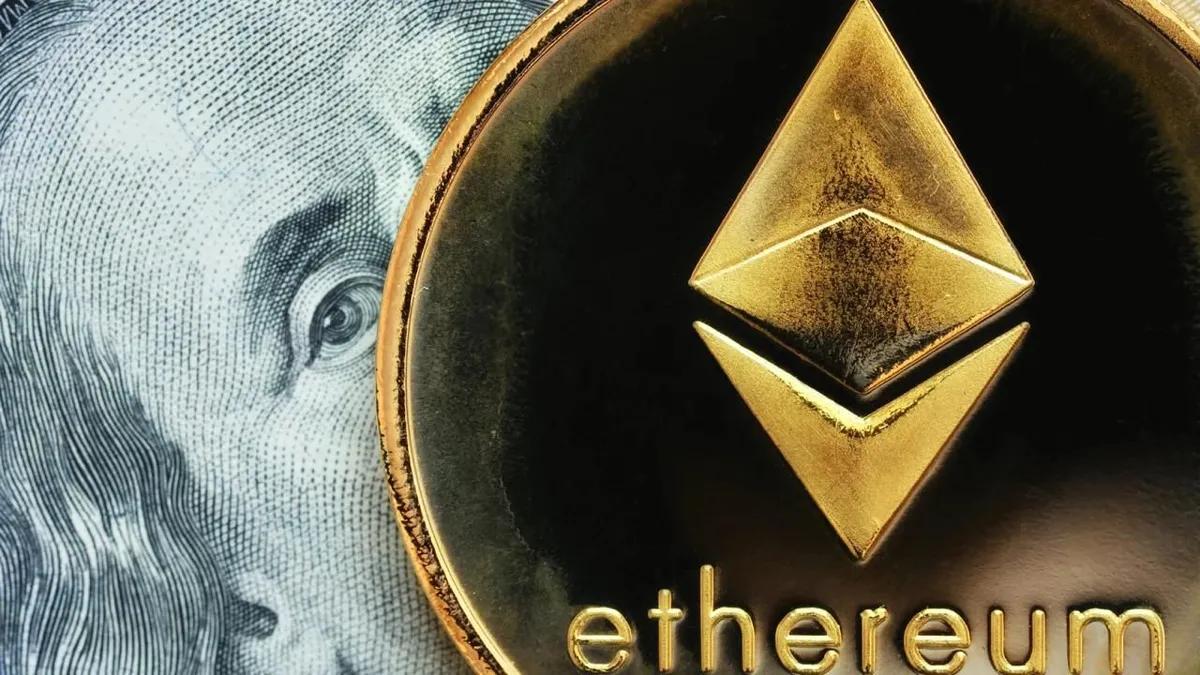
En av Ethereums største støttespillere solgte nettopp all sin ETH










 Ethereum (ETH)
David Hoffman, one of the most recognizable voices in the Ethereum community and co-founder of the major crypto media platform Bankless, has revealed that he sold all of his ETH holdings. The announcement immediately sparked heated discussion across the crypto industry, not because Hoffman suddenly turned against Ethereum, but because of the reasoning behind his decision.
In a lengthy breakdown explaining his position, Hoffman clarified that he still believes Ethereum as a network can continue to succeed and dominate important parts of the blockchain ecosystem. However, he no longer believes that ETH itself is the best asset positioned to capture the value created by that success. That distinction has become the center of the debate.
For years, one of the strongest narratives surrounding Ethereum was the idea that ETH would eventually become “internet money” - a globally important digital asset tied directly to the growth of decentralized finance, smart contracts, tokenization, NFTs, and on-chain applications. According to Hoffman, that thesis never fully materialized. Instead, Ethereum evolved into something more complex.
While the network itself became enormously important, the value generated on top of Ethereum increasingly started flowing toward applications, Layer-2 ecosystems, stablecoins, and infrastructure providers rather than directly into ETH as an asset.
Hoffman argues that Ethereum succeeded technologically but became economically fragmented.
One of the biggest examples he points to is the rise of Layer-2 networks. These are scaling systems built on top of Ethereum that process transactions faster and cheaper while still relying on Ethereum for security. L2s helped Ethereum scale and remain competitive, but they also changed how value flows through the ecosystem.
Rather than all activity happening directly on Ethereum mainnet and generating strong demand for ETH, more and more usage now takes place inside separate ecosystems built above it.

According to Hoffman, this weakens the direct connection between network growth and ETH price appreciation. He compares this to Bitcoin’s much simpler structure. Bitcoin intentionally removed complexity and placed the asset itself at the center of the ecosystem. Everything around Bitcoin ultimately reinforces BTC as the primary product and store of value. Ethereum took the opposite approach.
Instead of focusing purely on the asset, Ethereum expanded into decentralized finance, NFTs, tokenization, smart contracts, gaming, DAOs, and thousands of applications. That innovation made Ethereum one of the most important blockchain networks in the world, but it also created many separate centers of value extraction.
In Hoffman’s view, Ethereum became an entire digital economy rather than a system designed primarily to maximize ETH itself.
Stablecoins are another major example highlighted in his analysis. Stablecoin activity on Ethereum has exploded over the years, with billions of dollars flowing through the network daily. However, Hoffman notes that the main winner from stablecoin adoption is often the US dollar itself rather than ETH.

People use Ethereum infrastructure to move dollar-backed assets, but that does not necessarily create proportional long-term demand for ETH ownership.
This idea challenges one of the oldest assumptions in the Ethereum ecosystem: that massive network usage would automatically translate into massive ETH value capture. Hoffman believes the relationship is now far less direct.
Importantly, he does not describe Ethereum as failing. In fact, he still sees Ethereum as one of the dominant blockchain ecosystems and a critical foundation for decentralized applications. His decision is specifically about investment positioning rather than technological rejection.
That nuance is important because reactions online quickly became polarized. Some interpreted the announcement as proof that Ethereum is weakening, while others argued that Hoffman is simply adapting to a more mature understanding of how blockchain ecosystems evolve economically.
The discussion also reflects a broader shift happening across crypto markets in 2026. Investors are increasingly questioning which parts of blockchain ecosystems actually capture long-term value. In previous cycles, many assumed that network adoption alone guaranteed appreciation for native assets. Today, the market appears much more selective.
Ethereum now exists in an environment where value is spread across protocols, applications, infrastructure providers, L2 networks, staking ecosystems, and tokenized assets rather than concentrated entirely inside ETH itself.
Even so, ETH remains one of the largest and most influential cryptocurrencies in the world. The asset still plays a central role in staking, gas fees, security, and governance across the Ethereum ecosystem.

But Hoffman’s exit highlights an uncomfortable question that many investors are beginning to ask more seriously: can Ethereum continue winning as a network without ETH fully capturing the economic upside of that growth?
That debate is likely to remain one of the defining discussions of the crypto market for years to come.


 Vellykket kopiert... Takk for at du deler innholdet vårt!:



5% innskuddsbonus opp til 100 perler

0 % gebyrer på innskudd og uttak.





11 % innskuddsbonus + FreeSpin


10 % EKSTRA INNSKUDDSBONUS + 2 GRATISSPINN PÅ HJUL

Gratis case og 100 % velkomstbonus


5 gratis saker, daglig gratis og bonus

3 gratiskasser og en bonus på 5 % på alle kontantinnskudd.

+5 % til innskudd




Kommentarer