




MLB The Show 26-anmeldelse










 PlayStation
 Review
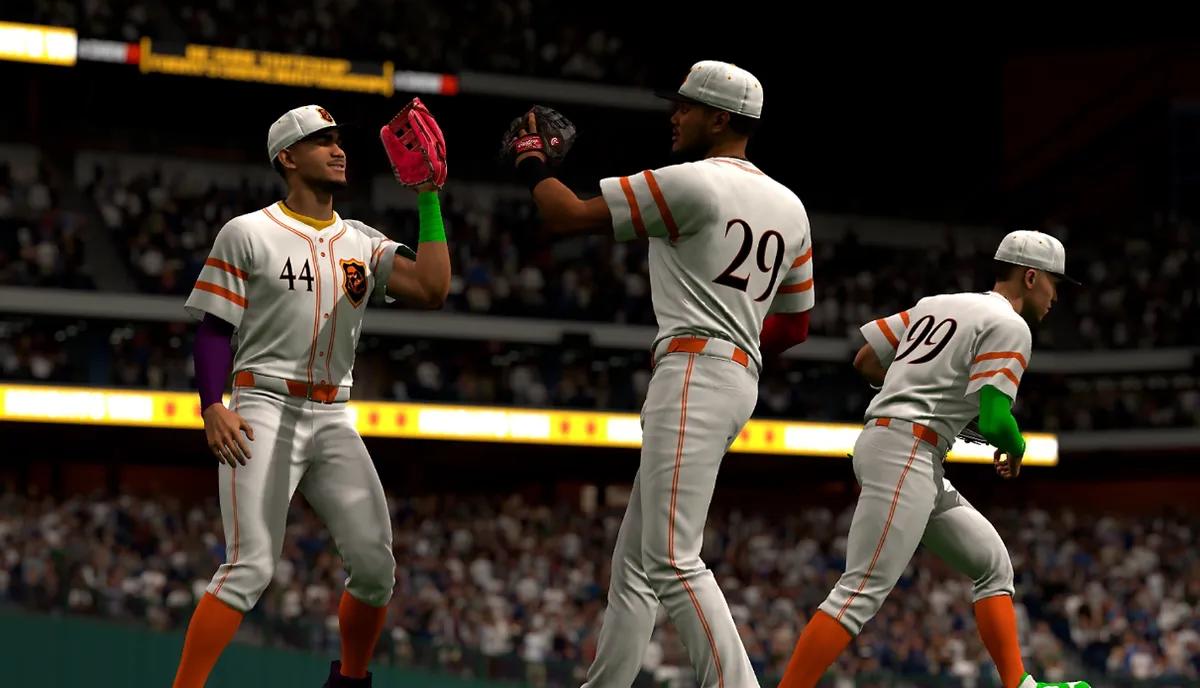
Sony San Diego Studio's MLB The Show 26 releases March 17, 2026 on PlayStation 5, Xbox Series X/S, and Nintendo Switch, arriving with the most substantive set of additions the series has delivered in several cycles. Bear Down Pitching debuts as the headline mechanical change on the mound, a new Franchise Trade Hub consolidates all roster management into a single interface, Road to the Show expands its early career arc with eleven new colleges and an officially licensed NCAA College World Series, and Diamond Dynasty launches with World Baseball Classic integration alongside a restructured Team Affinity program. March to October mode is removed without a direct equivalent. A 20-card Diamond Dynasty ownership cap was introduced without pre-launch disclosure. The on-field simulation holds its position as the most convincing baseball recreation in any current video game — a distinction the series has owned for years — and remains the most compelling argument for engaging with each new release.
The On-Field Game
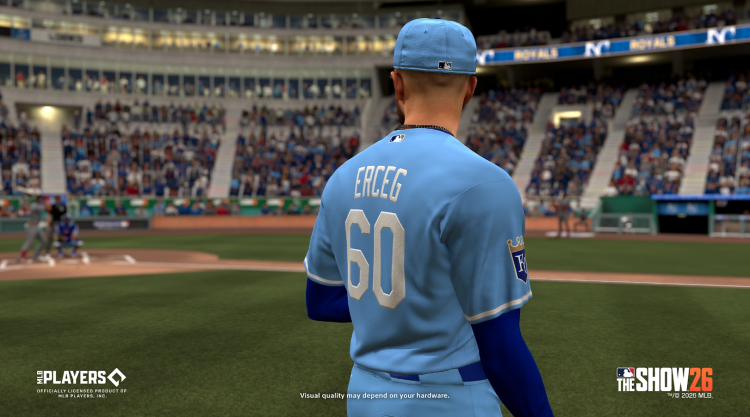
Baseball's three core mechanics — pitching, batting, fielding — execute at a level no competing sports title currently reaches. The animation system tracks variables that most games reduce to single outcomes: the route a center fielder takes based on contact sound and ball trajectory, the way crowd members in foul territory reach or flinch, the physical read a shortstop makes before a double play develops. These details accumulate into a simulation that feels physically inhabited in a way functional sports games do not approach.
Bear Down Pitching is this cycle's most meaningful addition. Consistent strike-throwing and strikeout accumulation bank a reserve of high-accuracy pitches deployable in pressure situations, each tied to the pitcher's Clutch rating. The command difference is concrete — a Bear Down delivery locates in the zone with precision that standard mechanics do not replicate at any difficulty setting. I pitched extended innings as Seattle's Bryan Woo on Simulation difficulty and felt the system reshape how full-count situations played out, holding Bear Down pitches for two-strike leverage rather than spending them on first pitches against weak hitters. Big Zone Hitting, the counterpart batting addition, simplifies plate coverage into broader quadrants and raises contact rates while flattening the skill expression that zone hitting previously enforced. More balls reach the field; fewer of them reward any specific reading of the pitch. Additional changes — depth-of-field toggle while batting, PitchComm audio through the DualSense speaker, pitch usage modeling that makes less-frequently-thrown offerings harder to locate — contribute individually without shifting the competitive register of the on-field experience at any level.
Road to the Show and the College Path
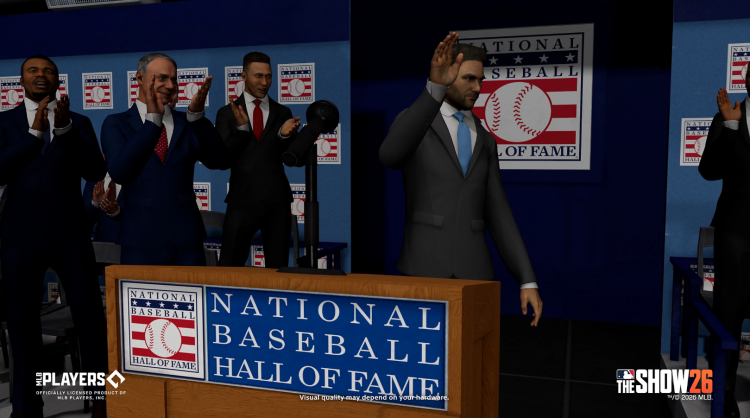
Road to the Show adds eleven new colleges and the first officially licensed NCAA College World Series appearance in series history. Smart Sim now ties a player's overall rating to simulated game statistics, allowing stretches of games to be skipped without career damage, and the system interrupts auto-sim before defined high-leverage moments to require live play. This is an overdue change that makes skipping games a genuine strategic tool rather than a risk. Female players remain available from the career's opening season, with co-ed minor league rosters treated as baseline rather than promotional. The new player onboarding — a structured walkthrough of every hitting, pitching, and fielding interface completed before the first live game — is the most comprehensive and accessible introduction the series has produced, genuinely useful for players approaching baseball simulation for the first time.
The college path resolves too quickly and provides too little. It deposits players directly into their junior year and the College World Series, presenting what should be a multiyear developmental arc as a single-event prologue. I expected the college phase to establish the career's emotional foundation before the professional arc began; it ended before any foundation had formed. Conversation sequences with coaches remain static text exchanges with click-to-confirm responses and stiff character animations unchanged across multiple prior entries. The mode moves efficiently and without narrative content, a condition that has persisted through the current console generation without sign of change.
Franchise Mode and the Trade Hub
March to October is gone. The mode placed players in high-leverage game situations throughout the regular season, connecting live results to seasonal momentum in a way that made individual at-bats feel consequential beyond their immediate outcome. Its replacement is a customizable simulation interface that allows players to define precisely which game states interrupt auto-sim for live play. The control parameters are flexible and the settings are well-organized. The contextual frame that gave individual moments seasonal weight does not transfer to the new system. Franchise without March to October is roster management and game-by-game baseball, each component functioning correctly but no longer feeding a larger seasonal narrative.
The Trade Hub is the mode's most significant structural gain and the single best addition in this year's release. All trade activity — rumors, pending offers, player valuations, multi-team competitive bidding — now operates from one interface rather than dispersed menus across multiple screens. Setting untouchable players, tracking competing general managers' activity, monitoring the market for specific positions, and pursuing simultaneous deal negotiations all happen from the same location. The result is the strongest roster management implementation the series has built, and it makes running a franchise feel like substantive decision-making rather than menu navigation. Custom stadiums built in previous entries do not transfer to this year's game. Road to the Show and Franchise saves from prior entries are not importable. The Stadium Creator is functionally unchanged from its Show 21 debut, carrying the same control limitations noted at its introduction five years ago.
Diamond Dynasty and the Ownership Cap
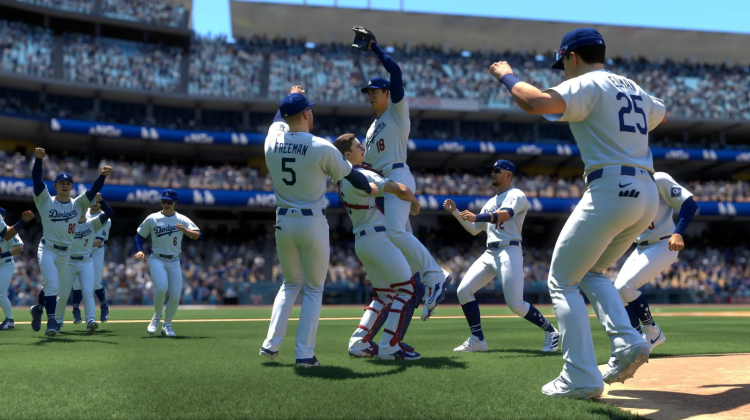
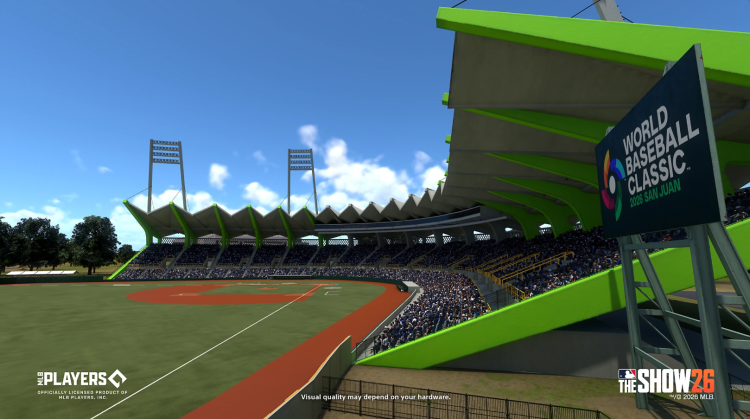
Diamond Dynasty launches with more content volume than any prior entry. World Baseball Classic integration delivers WBC-themed card programs, a dedicated conquest map, and a tournament bracket tying card collection directly to the international event. Team Affinity restructures into two year-long programs per franchise, providing a hitting captain and pitching captain for every team from day one. The Parallel Mod system allows players to choose which attributes to specialize as cards are leveled, introducing roster-building decisions that the mode has previously lacked.
A 20-card ownership cap introduced without pre-launch disclosure directly removes the most accessible competitive path for players who built rosters without real-money purchases. Card flipping and roster-update timing — acquiring cards ahead of real-world player performance and selling them at peak value — depended on holding capacity that the cap eliminates. I noticed the impact immediately when attempting the market activity that competitive free-to-play players relied on across prior entries; the ceiling on simultaneous holdings changes the math of that approach entirely. The Deluxe Edition starts with Aaron Judge, Shohei Ohtani, and other top-tier players already in the lineup. Diamond Dynasty challenges that bar duplicate players from appearing on both sides of a match mean that Standard Edition players face roster restrictions caused directly by what their opponents paid at checkout. The microtransaction store structure — 1,000 Stubs per dollar, scaling to 150,000 Stubs for $100 — is unchanged. All content remains earnable through gameplay. The undisclosed cap introduced a meaningful constraint on the competitive free-to-play community without giving that community the chance to prepare for it.
Negro Leagues Storylines
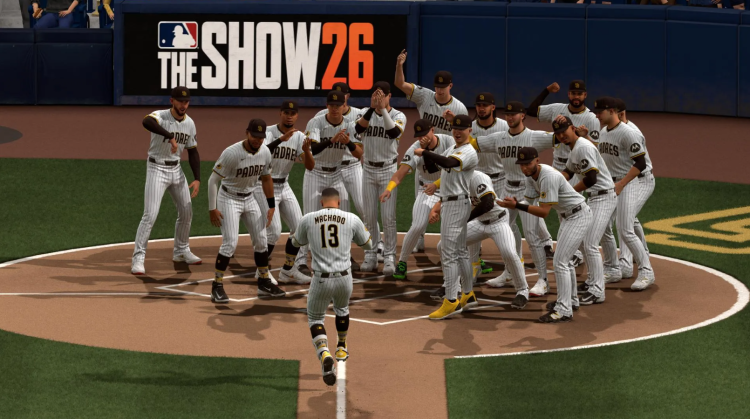
Storylines returns for its fourth season, profiling Roy Campanella, Mamie "Peanut" Johnson, John Henry "Pop" Lloyd, and George "Mule" Suttles. Produced video segments featuring commentary from Bob Kendrick, president of the Negro Leagues Baseball Museum, accompany playable recreations of each player's career-defining moments. Stadium reconstructions, period-accurate equipment, and crowd attire matching the era sustain the historical immersion the documentary framing establishes. The mode remains the most historically substantive content in any current sports game, and its fourth season demonstrates no sign of exhausting its material.
George "Mule" Suttles carries the season's most striking profile. When Major League Baseball integrated Negro League statistics into official records in 2024, Suttles ranked fourth in baseball history by slugging metrics, behind only Babe Ruth, Ted Williams, and Lou Gehrig — achieved across roughly a third of their plate appearances. Playing his career recreations with that statistical context transforms the moments. The gameplay challenges tied to these profiles — get a base hit, record a strikeout, prevent a run — are minimal by design and would not sustain the mode independently. The historical content carries it entirely, and the produced segments justify the time investment regardless of the gameplay attached to them.
Presentation and Technical Performance
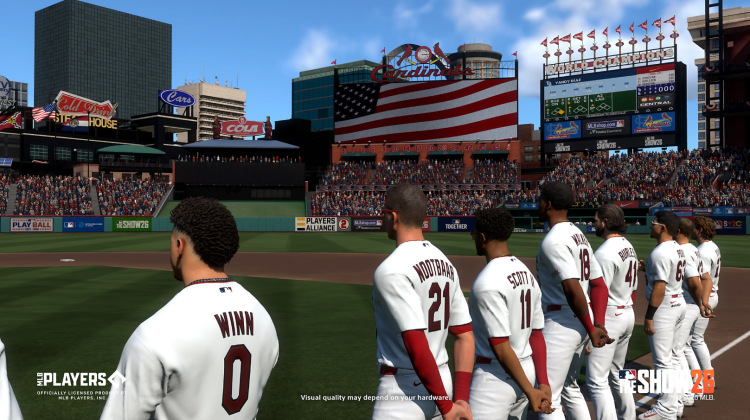
Player models, stadium geometry, and the core animation library are visually consistent with recent entries. Jersey physics show genuine improvement. Stadium lighting registers marginal gains. Aliasing remains visible in broadcast camera angles. Crowd geometry lags behind current-generation standards in other sports titles. No PS5 Pro enhancements are present — a notable omission for a first-party PlayStation release in 2026. Face scanning produces character models that approximate structure without accuracy. Commentary recycles lines from previous entries at a rate detectable within a single session.
Cross-play between PS5 and Xbox Series X functions with persistent problems. Batting presented rubber-banding on pitch delivery — ball position shifting just before the contact window — that disrupted direction reads on faster pitches. Outfielders intermittently declined to throw home after catching fly balls. The batting cage training mode has regressed from its previous implementation. These issues affect competitive play and remain unresolved.
Verdict
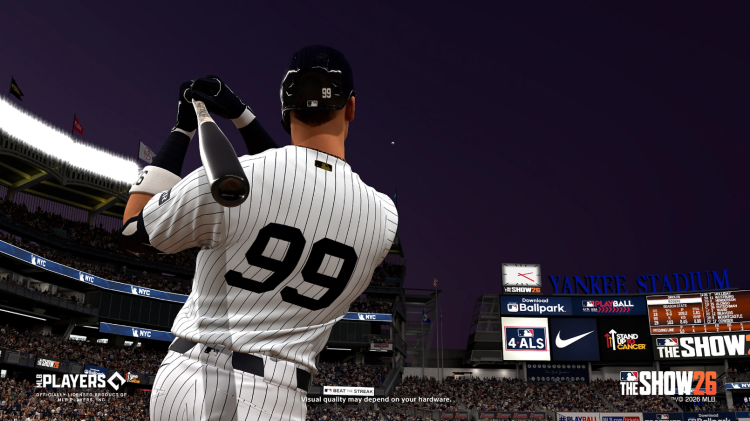
MLB The Show 26 is an 8/10 game. Bear Down Pitching and the Franchise Trade Hub are the most meaningful additions the series has delivered in several cycles, Negro Leagues Storylines continues to produce historically significant content at a level no competing sports game approaches, and the on-field simulation holds the standard it has maintained through years of annual releases. The undisclosed ownership cap, March to October's removal, and the absence of visual or technical advancement on current hardware prevent this from representing the structural evolution the series is capable of producing.
Pros:
- Bear Down Pitching is the most mechanically impactful on-field addition in recent series history, with a concrete command difference in high-leverage situations
- The Franchise Trade Hub consolidates all roster management into the strongest single-interface implementation the series has built
- Negro Leagues Storylines delivers period-accurate historical content and production quality that no current sports game matches
Cons:
- The undisclosed 20-card Diamond Dynasty ownership cap removes the most accessible competitive free-to-play path the mode has offered, without equivalent replacement
- March to October's removal leaves Franchise without the seasonal context that made individual game moments feel connected to a broader narrative arc
MLB The Show 26 is the best baseball simulation available in 2026, as it has been for most of the current console generation, and the Trade Hub and Bear Down Pitching give returning players concrete reasons to engage with franchise management and on-field pitching differently than before. Players who own The Show 25 will recognize most of this package on contact; players returning after two or more missed entries will find enough changed to justify coming back. The foundation has not moved, but the additions built on top of it are the series' best in years.


 Vellykket kopiert... Takk for at du deler innholdet vårt!:

Kommentarer