




Det ubeseirede fjellet: En historie om klatringen i Cairn-anmeldelse










 Review
 Spill
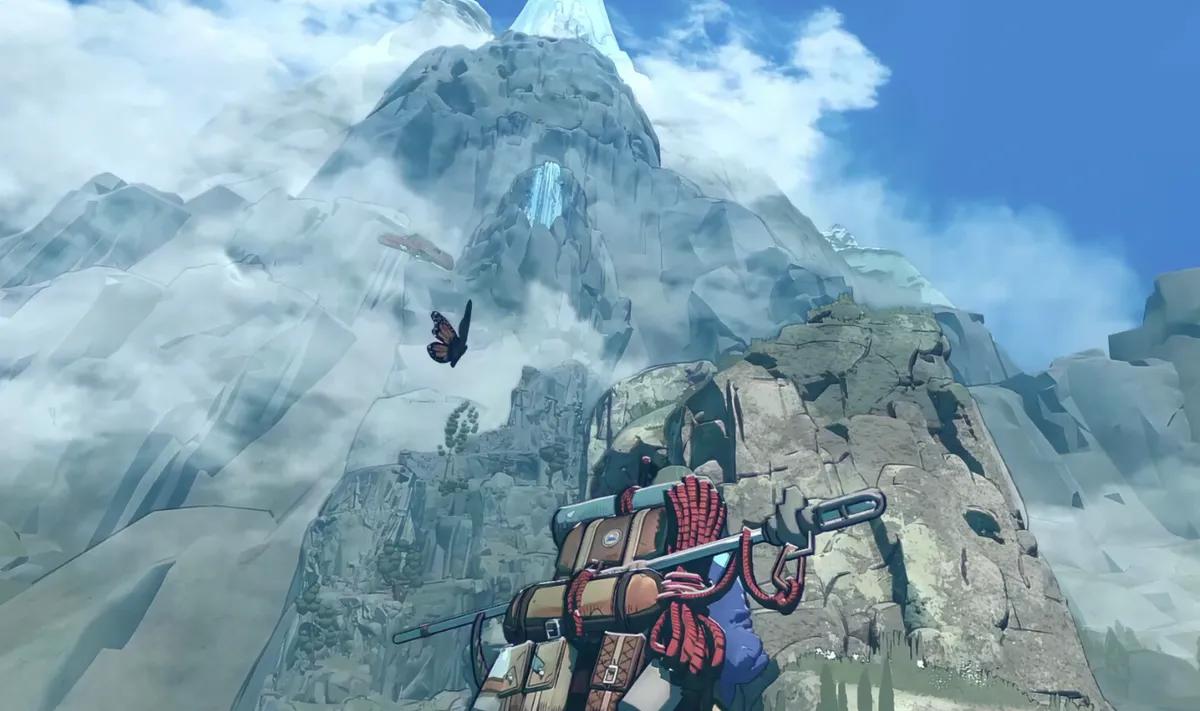
SpillCairn introduces its protagonist, Aava, with her eyes on the stars. She is a climber, and she has her sights set on the fictional, unconquered peak of Mount Kami, determined to be the first to summit. Her story is one of the climb itself. The game focuses on the intricate process of ascent. The player chooses the route up the mountain, finds the handholds, and takes chances on outcroppings that seem just out of reach. Control is granular, with each of Aava’s limbs managed independently. The path to the summit is a personal creation. Reaching the next Bivouac, a tent for rest and recovery, becomes a significant goal.
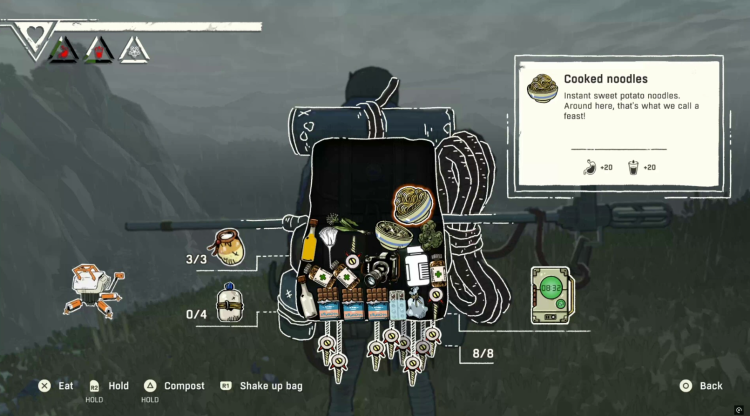
Here, Aava can re-tape her fingers, cook food, and repair pitons damaged during the climb. The game tracks Aava's temperature, hunger, hydration, and health. Managing these meters is essential for survival. A failure to feed Aava results in diminished strength, making climbing more difficult. The system holds the player accountable for their choices but rarely feels overly punishing. The challenge of managing limited resources against the mountain's demands is a rewarding loop.
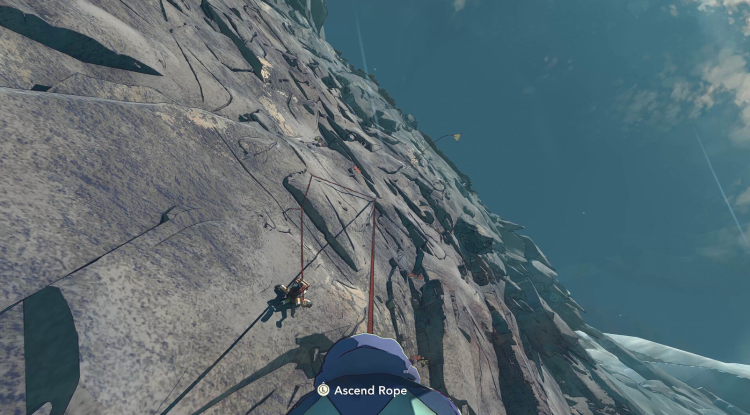
Aava’s stamina and grip strength are not represented by a meter. The player must watch her physical state directly. Her arms and legs tremble on an unstable hold. Her breathing changes. She whimpers and winces as her grip is about to fail. These tells are subtle at first, requiring the player to learn her physical language and how to position her correctly. Aava is strong but human. She cannot cling to smooth rock for long periods or ascend a sheer cliff through will alone. Shaking out a tired limb while on a stable hold can buy more time, but the entire mountain cannot be scaled this way. Progress is found in small divots for her hands, tiny ledges for her feet, and cracks in the cliff face for her toes. At times, no clear path exists, forcing a risk. Aava might brace a leg against a flat surface, hoping to pull herself up before her strength gives out, or sidle across a small ledge with hands pressed against smooth stone. When the rock is suitable, she can drive a piton into the mountain to build a belay, clipping herself to a rope to rest. If she falls from a position protected by a piton, her Climbot helper will catch her. She can then climb the rope back to the belay or use it to rappel to a new area. Mistakes are possible even with these tools. A player might realize the need for a belay too late or twist a piton while driving it in, preventing its full recovery later. On dense stone, the climb must be made unaided. These are the game’s most memorable moments. Falls are inevitable. The question is whether they are fatal and how much time is lost.
A bird’s eye view is available at any time, showing the current location and the route taken so far, including failed past attempts. This perspective is crucial for planning the next leg of the ascent. There are no wrong routes. Some paths are clear but slow. Others are faster but more difficult and require more risk. Often, the route is a compromise, forcing the player to choose the nature of the challenge. There are moments of realizing a better, easier path was available only after committing to a difficult section. Smart choices, chalk to increase grip strength, and well-placed pitons can overcome some of these situations. Other times, adjusting the path is the better option. Climbing Kami is an exhilarating experience. The act of looking up at a seemingly impossible path and later looking down from that very spot brings a sense of accomplishment. Joy is found in planning a route, securing a piton just before a fall, finding the right handhold, or wedging Aava’s feet into a crevice to unlock a path. Daring to persist through a difficult section in the rain instead of waiting on a belay offers its own thrill. The game’s core climbing mechanics remain consistent, and while Aava’s limbs can occasionally move unnaturally or she might clip through the environment, the investment in her journey makes these minor issues feel insignificant.
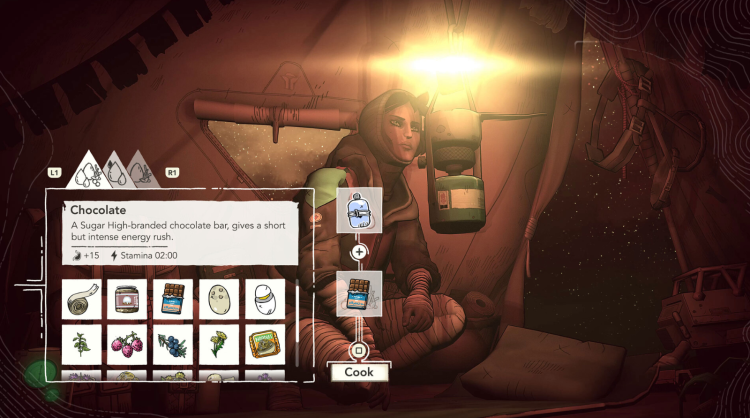
At a Bivouac, which also functions as a save point, there is always more to do. Aava’s hands, scarred and bloody from the climb, need to be taped. The Climbot needs to craft new pitons from salvaged scraps. A meal must be cooked, and water must be consumed. Aava’s backpack has limited space. Every resource used, be it a chocolate bar or a piece of tape, is a resource that might not be available later. Sleep restores Aava, but she wakes up hungry. The mountain forces compromise. Climbing at sunset is dangerous due to low visibility; climbing at night is nearly impossible and reserved for emergencies. Sometimes, rest is not for physical need but to wait for sunrise. Yet, the mountain also provides. Dandelions for tea, raspberries, fresh water, and fish can be found in caves and on ledges. Survival is a constant balancing act, but collapse is never absolute. There is always just enough, with smart management. The Climbot recycles used plastic and bottles to make chalk. Each part of the journey feeds another. The mountain’s story unfolds through exploration. The remains of a cable car station, smashed vending machines, and old advertisements reveal a past where tourists once walked these paths until it was no longer profitable. The ruins of a troglodyte civilization, with cities carved into the rock and great statues, speak of a culture that resented climbers like Aava.
“My mountain belongs to everyone,”
— Aava
But as Aava climbs, she walks through the graveyard of a culture people like her helped displace, their constructions now marked by pitons and climbing rope. The cost of her attempt is ever-present. Bear-proof boxes full of supplies and abandoned backpacks are subtle hints of others who came before. The discovery of dead bodies is a starker reminder.
“Sometimes you come for the mountain,”
— Aava says, kneeling over a fellow climber.
“Sometimes the mountain comes for you.”
Abandoned campsites tell their own stories. The player learns of a group that was tracking bears, a climbing team of two orphans who sought to conquer Kami together, and a couple who scaled the mountain in increments. These narratives build upon themselves as Aava ascends. The game is not just Aava’s story; it is about Kami and everyone who has attempted to climb it. The outcome for them seems binary: turn back or die. The mountain remains unconquered. Aava’s own story is revealed through messages relayed by her Climbot. Her agent, Chris, shifts from begging for sponsor photos to just wanting to know she is all right. Her friends sing her happy birthday. Her partner, Noami, does not understand her drive and reminds her of the costs. Aava mostly ignores them, her focus on the climb. She meets another climber, Marco, a fan who grew up reading about her. She is terse with him, not out of malice but out of her singular focus. The quest for the summit is as much about running away from the world below as it is about climbing toward the peak. The game delivers its narrative in pieces, through hints and what is left unsaid. When Marco mentions her father, also a climber, Aava’s curt response hints at a complicated history. She is complex and imperfect, but her motivations are always understandable.
The end of Cairn presents Aava with a choice about who she is, what she is willing to sacrifice, and how the climb has changed her. It is a fusion of gameplay and storytelling, a culmination of everything experienced on the mountain. Each choice leads to a different, equally valid ending. The final hours of the game are memorable. The journey, the moments facing Kami’s challenges, from sheer cliffs to bad weather, is what gives the game its meaning. The reward for each hard-won ascent is something wondrous. By the end, the player is as attuned to Aava’s body as their own. The story of the mountain and its people, the climb, and Aava herself are what remain. Kami asks Aava two questions:
“Who are you? Why are you here?”
Her answers are simple.
“I’m a climber. I came here to live.”
Read also our earlier preview, Cairn And The Cost Of Every Grip, which detailed how the game's opening hours establish a mountain that decides who is allowed to pass, where every movement costs energy and safety is something constructed slowly, if at all.


 Vellykket kopiert... Takk for at du deler innholdet vårt!:



5% innskuddsbonus opp til 100 perler

0 % gebyrer på innskudd og uttak.





11 % innskuddsbonus + FreeSpin


10 % EKSTRA INNSKUDDSBONUS + 2 GRATISSPINN PÅ HJUL

Gratis case og 100 % velkomstbonus


5 gratis saker, daglig gratis og bonus

3 gratiskasser og en bonus på 5 % på alle kontantinnskudd.

+5 % til innskudd




Kommentarer