




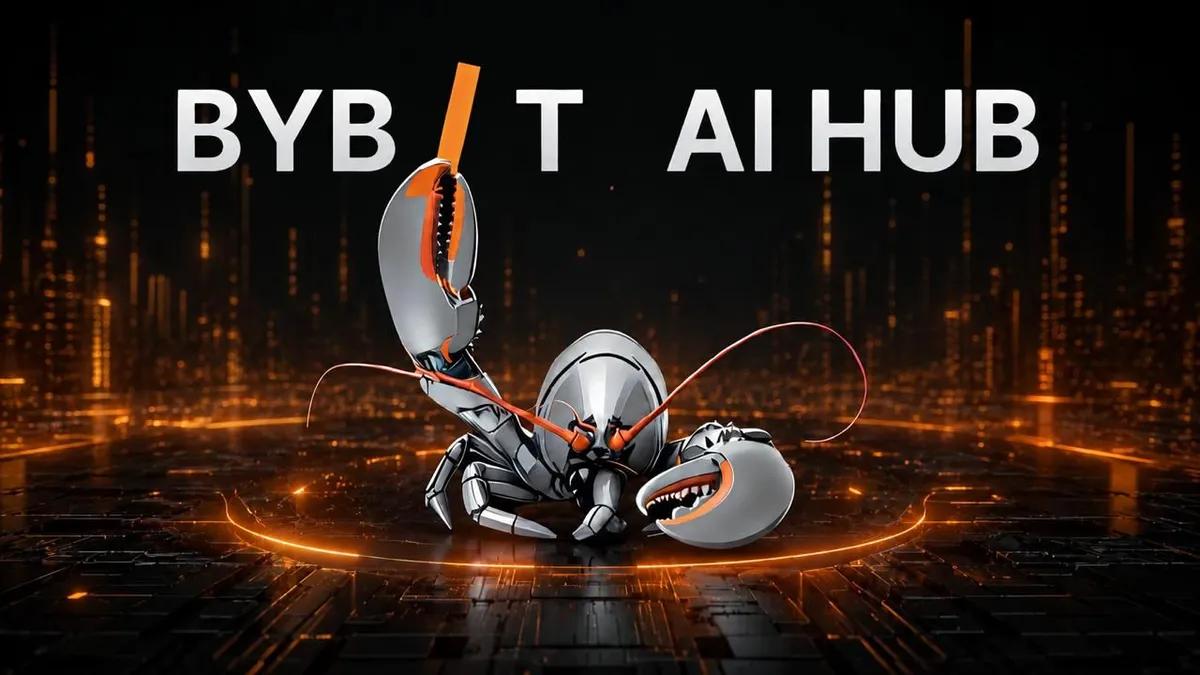
Bybit introduserer AI-underkontoer for handel med AI-agenter som Claude Code og Cursor










Bybit has introduced a new feature called AI sub-accounts, designed to let traders use AI agents in trading without giving them full access to their main exchange accounts. The idea is to separate automation from core funds by creating an isolated environment where AI tools can operate under strict limits. Instead of connecting an AI agent directly to a main account, users can now assign it to a dedicated sub-account with controlled permissions and capital, which significantly reduces the risk of losing full portfolio control due to automation errors or unexpected behavior.
This system is aimed at users who want to experiment with AI-driven trading strategies using tools like Claude Code, Cursor, OpenClaw and other automation frameworks. These AI agents can connect through API access and perform actions such as analyzing market data, executing trades, opening and closing positions, and adjusting strategy parameters in real time. However, all of these actions are restricted to the sub-account environment and cannot affect the main account or other sub-accounts unless the user explicitly allows transfers. This separation creates a layered security structure that is closer to institutional risk management practices than traditional retail trading setups.
One of the key features is capital control. Users can allocate a fixed amount of funds to an AI sub-account, with a default maximum limit of around 5000 dollars, although this threshold can be adjusted depending on user preferences and risk tolerance. This makes it possible to test aggressive or experimental strategies without putting an entire portfolio at risk. If an AI agent makes incorrect decisions or behaves unpredictably in volatile market conditions, the downside is limited to the allocated amount rather than the full account balance.
The system also includes detailed risk management settings that give users more granular control over AI behavior. Traders can define leverage limits for margin and futures trading, restrict or fully disable transfers between accounts, and set permissions for what the AI is allowed to do in the market. Access is API-only, which means AI agents cannot log in through standard authentication methods. This reduces exposure to account takeover risks and ensures that automation is strictly governed by programmable rules rather than manual login access.
Bybit’s approach reflects a broader shift in the crypto industry toward structured AI integration rather than uncontrolled automation. Instead of fully autonomous trading bots operating without limits, the platform encourages a sandbox model where AI systems function as controlled assistants. This allows traders to deploy multiple AI agents simultaneously, each running different strategies such as scalping, arbitrage, grid trading, or trend-following models, all isolated from one another.
Another important aspect of this system is testing and optimization. Traders can use AI sub-accounts as experimental environments to evaluate how different models perform under real market conditions. This is particularly useful for quant traders and developers who want to compare strategies or fine-tune algorithmic behavior without risking core capital. Successful strategies can later be scaled gradually into larger allocations once they prove consistent performance.

At the same time, the system acknowledges that AI trading is still inherently risky. Even advanced models can misinterpret market signals, react poorly to sudden volatility, or overtrade in unstable conditions. There is also the possibility of flawed strategy design or unintended consequences from poorly configured prompts and logic. By isolating these systems, Bybit reduces systemic risk while still allowing innovation.
Overall, AI sub-accounts represent a step toward more structured and safer adoption of artificial intelligence in financial markets. They allow users to benefit from automation while maintaining clear boundaries between experimentation and real capital exposure. This hybrid approach combines human oversight with machine execution, creating a framework where AI can assist trading decisions without fully replacing user control. As AI continues to evolve, such systems may become a standard across exchanges, forming the foundation for a new generation of semi-autonomous trading infrastructure.


 Vellykket kopiert... Takk for at du deler innholdet vårt!:



5% innskuddsbonus opp til 100 perler

0 % gebyrer på innskudd og uttak.





11 % innskuddsbonus + FreeSpin


10 % EKSTRA INNSKUDDSBONUS + 2 GRATISSPINN PÅ HJUL

Gratis case og 100 % velkomstbonus


5 gratis saker, daglig gratis og bonus

3 gratiskasser og en bonus på 5 % på alle kontantinnskudd.

+5 % til innskudd




Kommentarer