




Anmeldelse av Aether & Iron










 Review
 Steam
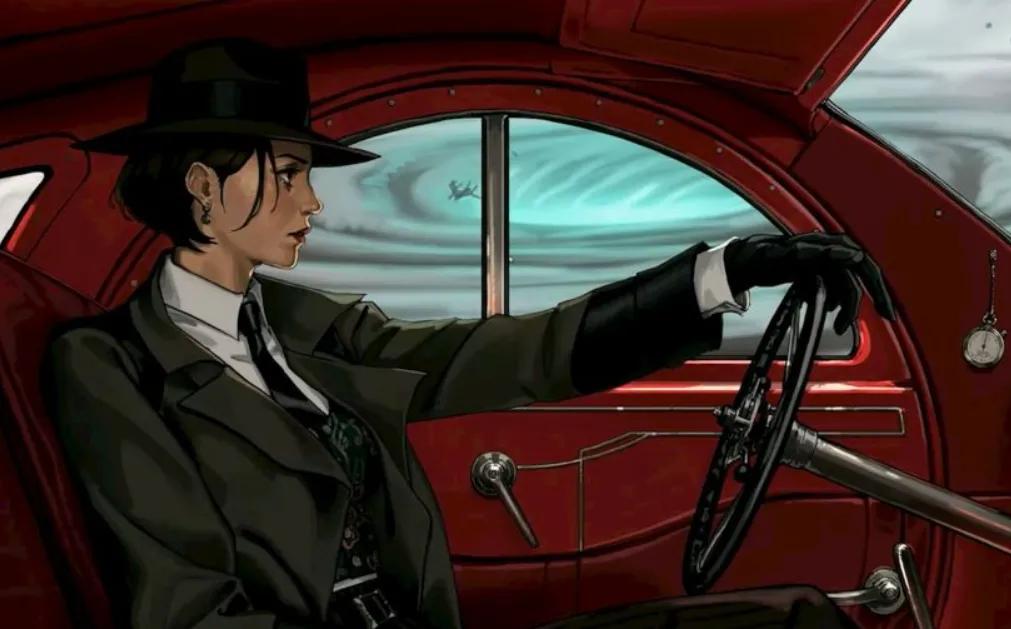
SteamSeismic Squirrel's Aether & Iron is a tactical RPG set in a 1930s New York that never landed — aether technology lifted the city's boroughs off the ground and left them floating, each one now controlled by a separate dictator. Protagonist Gia Randazzo is a smuggler with a ruined reputation who gets hired to escort a young scientist named Nellie from the upper districts to the lower ones, a job that pulls her into a revolution before the first act ends. The game splits its time between turn-based car combat on elevated highways and a visual novel-style narrative delivered through fully voiced dialogue and 2d6 skill checks. Those two halves pull in the same direction more often than not, which is the main reason the game is worth the time it asks for.
A City That Never Touched Ground
New York in Aether & Iron is not a single city. The aether resource lifted its districts off the ground and split them into floating islands connected by ferry routes. Three of those islands form the main map Gia navigates: one run by a military dictator, one by a capital baron, and one by a religious authority. The game does not treat these power structures as interchangeable evils. The military dictator resorted to weapons of mass destruction after peace negotiations collapsed on him. In the theocratic fiefdom, the lowest class of workers, called aetherneers, describe being treated better there than anywhere else in the city, which makes their loyalty legible rather than absurd. The writing keeps stopping to ask what holds these systems together, not just what makes them wrong. That restraint separates the worldbuilding from the kind of dystopian fiction that assigns all the cruelty to characters with no interior life. None of the barons are drawn as pure antagonists, which makes the revolutionary plot Gia gets swept into feel like an actual argument rather than a predetermined verdict.
The Highway as a Battlefield

Combat puts up to three vehicles on a long rectangular grid and asks the player to either destroy enemy cars or survive to the end of the encounter. Each car carries a loadout built before the fight: engine, repulsor, weapons, storage, and armor, all balanced against a weight limit. Light cars can carry a range of weapons and move fast, but absorb damage poorly. Tow trucks hit hard and support allies. Vans absorb collision damage and deal it back. None of this can be changed once the fight starts, which means preparation matters. The action point economy favors falling back over pressing forward — accelerating up the grid costs more than weaving backward through traffic — so the combat naturally pulls players toward managing position from the rear rather than charging in. Between turns, environmental hazards drop into marked zones on the road. Heavy metal rains from overhead. Civilians driving through the combat take collateral hits. For greater difficulties, working the hazards into the plan is required, not optional. This is what stops the combat from becoming repetitive: the stage changes every round, and the solution changes with it.
Talking Through the City

The story sections run as a visual novel. Each location is a 2D environment with points of interest to click on and NPC portraits that slide in from the edge of the screen, cycling through a handful of distinct expressions. Conversations lead to skill checks, rolled as 2d6 plus the relevant skill score: Gumshoe for investigation, Grease Monkey for mechanical problems, Smooth-Talker for negotiation and price-setting. Failures do not end scenes — they redirect them. The dialogue written around a failed roll is often more interesting than the success path. At a party inside a sinisterly well-appointed mansion, the path through involved convincing an avant-garde artist that her cattle-paint project deserved admiration, stealing her paint, and dumping it on a guard's car as a distraction — none of which required a single combat round. A character Gia recruited during an earlier sidequest reappears later in a worse situation, which Gia's intervention created. The linearity of the main plot does not prevent the story from carrying consequences.
Compared to Disco Elysium, which this game resembles in structure and tone, Aether & Iron is leaner. There is no isometric space to walk through, no loading screen between your character and the next conversation. The pacing is faster. Whether that trade-off works depends on what you want from this kind of RPG, but the game covers more ground per hour than most entries in the genre.
A Cast That Holds Up

Gia's voice actor delivers the hardboiled narration without pushing it into parody. The script gives her lines that run dense with metaphor and observation, and the performance keeps them from collapsing under their own weight. The supporting cast receives the same level of care. Christopher Tin, a two-time Grammy-winning composer and Grammy-nominee Alex Williamson wrote the score, which was recorded with a live orchestra. The strings and brass track the noir setting without becoming a pastiche of it. A scene where the crew spends downtime at a bar — no mission, no objectives — works because the personalities have been built up enough by that point to make the low-stakes conversation worth watching.
Where the Systems Stop

Several mechanics get introduced and then stop mattering. Heat builds when Gia takes risky actions and theoretically complicates checkpoint navigation, but its effect on gameplay stays minimal throughout. A cargo-smuggling system appears in the first few hours and then fades from relevance. The storage inventory exists but demands little. Money stays tight, which would normally push players toward hard choices, but the tight budget mostly redirects toward buying dialogue rerolls and repair kits rather than new vehicles or loadout changes. I think the resource loop needed one more layer of pressure between the economic constraints and the tactical decisions, because the gap between the interesting premise and its execution is wide enough to feel in a standard playthrough. The difficulty spike at the end of Act One is sharp enough to require loading an earlier save with shop access, which cracks the momentum the game built over the previous hours.
A Launch in Need of Repair

The technical state at release creates friction throughout. Load times run long. Black screens interrupt transitions. The save system does not consistently record the most recent progress. Voice actors occasionally misread a line and then deliver the corrected take immediately after, with both versions left in the audio. Dialogue loops without cause. On a controller, some menus — including the equipment screen and car swap screen — are difficult or impossible to use. Volume levels swing enough between scenes that a volume adjustment mid-session is common. The developers addressed a progression-blocking bug within a day of it being reported during review, which suggests the team is watching the build closely. The launch state, though, is rough in ways that slow down engagement with the material that earns attention.
Verdict

Aether & Iron is a 7.5/10 game. The worldbuilding, voice acting, live-orchestra score, and dynamic combat foundation are all strong; the technical problems at launch, the shallow secondary systems, and the momentum-breaking difficulty spike prevent the game from fully delivering on what those foundations set up.
Pros:
- A fully voiced cast backed by a live orchestra score that avoids genre parody
- Car combat with dynamic road hazards that forces a different tactical puzzle each fight
Cons:
- Multiple launch-state bugs, including save failures, dialogue loops, and broken controller menus
- Several mechanical systems introduced early that stop mattering by the midgame
Aether & Iron covers roughly thirty hours, and most of those hours move. I keep returning to the aetherneers in the theocratic fiefdom as the clearest example of what this game does when it commits: a detail that complicates the argument rather than simplifying it. The bugs are real problems, not light friction. For players willing to work through the roughness of the current build, the story and the road between fights offer more than most tactical RPGs manage.


 Vellykket kopiert... Takk for at du deler innholdet vårt!:



5% innskuddsbonus opp til 100 perler

0 % gebyrer på innskudd og uttak.





11 % innskuddsbonus + FreeSpin


10 % EKSTRA INNSKUDDSBONUS + 2 GRATISSPINN PÅ HJUL

Gratis case og 100 % velkomstbonus


5 gratis saker, daglig gratis og bonus

3 gratiskasser og en bonus på 5 % på alle kontantinnskudd.

+5 % til innskudd




Kommentarer