




Anmeldelse av Earth Must Die finner et kompakt komedieeventyr fullpakket med gåter og støy










 Spill
Spill Review
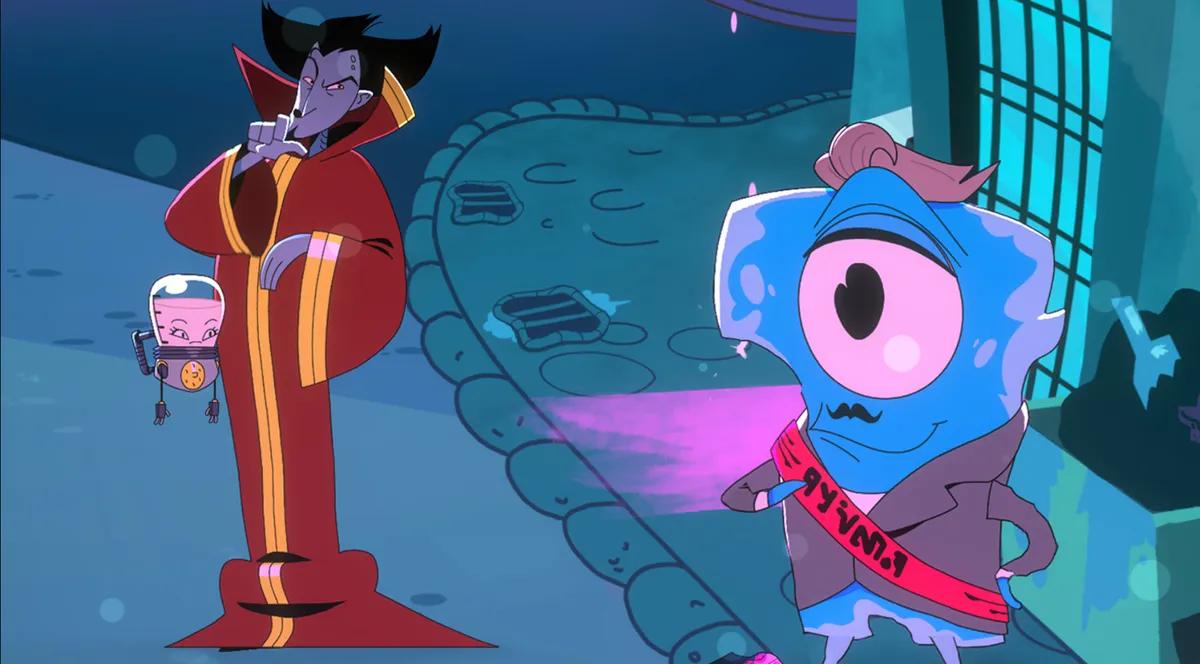
Earth Must Die arrives as a new point-and-click adventure from Size Five Games, released on January 27, 2026 and published by No More Robots. The game places players in control of VValak Lizardtongue, Grand Shepherd of the Tyrythian Ascendancy, an accidental ruler who reached the throne by arranging the deaths of his larger siblings. He leads an interstellar empire under invasion from Earth, a planet treated here as a punchline as much as a threat. VValak is cowardly, self-absorbed, and dependent on his only advisor, a floating robot named Milky, designed to nurse infants. The setup defines both the narrative and the mechanics, with incompetence baked into nearly every interaction.
The game was reviewed on a high-end PC setup, using an RTX 4090, Intel i9-13900K, and 32GB of RAM. Steam Deck compatibility remains unlisted. Visually, Earth Must Die leans into flat, exaggerated animation and clean interface design that supports rapid scene changes. The presentation draws from 1990s adventure games and television animation associated with Cartoon Network and Adult Swim. Scenes move quickly, rarely lingering once a puzzle resolves.

Size Five Games returns to adventure design after experimenting across genres, including football management, stealth, and platforming. Earth Must Die reconnects the studio with its earlier work by centering on inventory puzzles, dialogue trees, and environmental manipulation. The game pushes comedy constantly. Nearly every screen carries jokes, visual gags, or dialogue punchlines. That pace defines the experience as much as the puzzle design.
The central conflict revolves around the Ascendancy’s need to destroy planets to harvest pink goo, the substance that powers its systems. Early in the game, VValak attempts to activate a planetary scanner. The machinery no longer functions due to bureaucratic neglect, leading to one of the game’s representative puzzles. To repair a large activation button, VValak infects it with a microscopic civilization programmed to fix internal damage. When that civilization goes off task, VValak and Milky shrink down to investigate from within.

This sequence highlights both the game’s strengths and its excesses. The concept sets up layered puzzles and scale shifts, but the scenario detours into extended jokes involving a sex shop built by the microscopic society. Progress stalls as the game leans on repeated gags and direct commentary. Puzzle solutions during this section rely heavily on dialogue interactions and provide limited resistance.
“I confess did elicit a fair few chuckles out of me, because I am a very childish 40 year old.”
— Fraser Brown
Other sections balance humor and mechanics more effectively. One standout puzzle places the player in a scenario modeled after a cruise ship assassination, referencing Hitman’s Agent 47. The solution requires manipulating teleporters, learning an alien language, and observing creature behavior to trigger chain reactions. These puzzles reward attention and experimentation rather than brute force dialogue cycling.

The game frequently interrupts puzzle-solving with jokes, but not all interruptions derail momentum. In later sequences involving alien orgies, the humor integrates more closely with puzzle logic, tying visual chaos to mechanical steps. These moments still rely on shock value, but they avoid fully stalling progress.
Several running gags double as systems. VValak’s ignorance of his own empire justifies the Milkypedia, an in-fiction encyclopedia maintained by Milky. Players consult it for background details and hints. It functions as a built-in hint system without breaking immersion. Information updates frequently and adapts to current objectives.

Another defining mechanic comes from VValak’s refusal to touch anything he considers beneath him. He cannot interact with objects directly. Instead, he orders others to act on his behalf. Milky handles most interactions early on, but later puzzles introduce additional helpers. These include giant mosquitoes, hybrid animals, and a heist crew controlled remotely. Each assistant comes with limits, forcing players to sequence commands carefully.
Earth Must Die runs just under eight hours for a full playthrough. Despite its length, it presents a high density of puzzles. The game often nudges players toward solutions, sometimes too quickly, but most challenges remain distinct. Physical comedy, sudden violence, and slapstick outcomes appear regularly. Fail states tend to be brief and reversible.

The voice cast contributes significantly to the game’s identity. Joel Fry voices VValak, delivering a performance that balances arrogance and panic. Mike Wozniak, Alex Horne, and Tamsin Greig appear across multiple roles, voicing aliens, robots, and minor characters. Their delivery supports the rapid-fire script, keeping dialogue readable even when jokes stack tightly.

Earth Must Die positions itself within a sketch comedy structure. Scenes operate as self-contained setups that introduce a premise, escalate it through puzzles, and exit before overstaying. This approach produces frequent tonal resets. When jokes fall flat, the game moves on quickly. When puzzles land, they rarely receive time to breathe before the next gag arrives.

That structure distinguishes it from more naturalistic adventure games. While some recent titles favor restrained humor, Earth Must Die pushes volume and frequency. It rarely refuses an easy joke, even when that choice undercuts more intricate ideas. The result is uneven but active, with constant motion masking misfires.

Earth Must Die review impressions suggest a game that succeeds through momentum rather than consistency. It delivers inventive puzzles, committed performances, and an unbroken stream of jokes. Some sections exhaust patience. Others surprise through clever design. The game never attempts subtlety, but it maintains focus on interaction and pacing.
Earth Must Die is available to play on PC through Steam.
Read also, Code Vein 2 arrives as a follow-up to the 2019 anime-style soulslike, but extended play reveals uneven execution. The time-traveling open-world structure sustains interest through its main quest and side content over roughly fifty hours, yet fluctuates sharply in quality across combat, systems, and narrative cohesion.


 Vellykket kopiert... Takk for at du deler innholdet vårt!:



5% innskuddsbonus opp til 100 perler

0 % gebyrer på innskudd og uttak.





11 % innskuddsbonus + FreeSpin


10 % EKSTRA INNSKUDDSBONUS + 2 GRATISSPINN PÅ HJUL

Gratis case og 100 % velkomstbonus


5 gratis saker, daglig gratis og bonus

3 gratiskasser og en bonus på 5 % på alle kontantinnskudd.

+5 % til innskudd




Kommentarer